
Family Enterprises in a Region under Pressure | The Human-Centric Leader
A lesson we have learned over the last 20 years from studying family enterprises in the MENA region is that in a crisis, the first priority is people.
In the midst of profound regional instability, a familiar pattern is emerging. For some family enterprises, this is the first such disruption in a lifetime. For many others, however, navigating crisis is a learned skill, honed over decades of volatility and war. Yet, for both, we observe that the first response is the same: they look to their people.
But we have to be clear: this is a response that goes beyond “corporate social responsibility” or philanthropic efforts. Rather, it’s a behaviour revealing a fundamental truth about what it takes to build a business that lasts for generations.
The First Instinct: Securing Your Key Stakeholders
Across the Tharawat network, we have seen this human-centric instinct play out in real-time. Of course, our natural reaction is first to turn to our own family and make sure that they are secure. But the immediate second reaction we observed was that at the same time as balance sheets were stress-tested or supply chains were secured, the well-being of people was the focus. And the actions were practical, immediate, and community-focused.
For example, owning families rapidly established dedicated communication channels – groups where employees could share challenges, seek support, and help one another. Emergency plans were activated not just to protect physical assets, but to ensure the physical and financial safety of staff and their families. The focus on security naturally extended beyond the immediate family and employees to encompass key stakeholders, recognising that the entire business ecosystem may be under threat.
These are not items on a generic crisis-management checklist. They are the intuitive actions of leaders who see their organisation not as a machine for generating profit, but as a community of people.
An example comes to mind from a Syrian family from our network – who throughout the past 15 years have continued supporting their workforce in their home country, even though the operational realities were fractured and often interrupted. Despite that they remained dedicated, which allowed them to re-activate their operations within a few days when the signs of a new dawn appeared. It is a symbol of a stakeholder conscious family enterprise to continue supporting their communities, sustaining jobs through incredible moments of hardship, and continuing to invest in and supporting their employees – despite not knowing when the hardship would end.
Beyond Philanthropy: Community as a Strategic Asset
Why is this human-centric approach so prevalent in family-owned enterprises? While it stems from a genuine sense of empathy and responsibility, it is also a deeply strategic imperative.
Researches have described the concept of Socioemotional Wealth (SEW)(https://www.sciencedirect.com/science/article/pii/S0263237322001487) as the non-financial value that family owners derive from their business – their name and reputation, the ability to pass on a legacy, and the social capital built through generations of trust with their community. In a crisis, it is this wealth that is often prioritised above short-term financial gain.
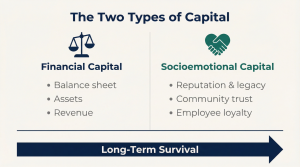
The Two Types of Capital. Copyright Tharawat Family Business Forum, 2026.
Protecting people is not a cost centre; it is the protection of the single most critical asset a family enterprise possesses. It is the bedrock of long-term survival and the most important foundation upon which a business can grow, build, and rebuild, time and time again.
About the Family Enterprises in a Region under Pressure Article Series
Family enterprises in the MENA region are facing unprecedented challenges – from geopolitical uncertainty and economic shifts to complex generational transitions.
In this article series, our General Manager, Farida El Agamy, draws on more than fifteen years of experience working with family enterprises across the region to reflect on the forces reshaping them today. Each article combines informed perspective with practical, on-the-ground insight, exploring key themes shaping the sector. The series aims to spark meaningful dialogue, deepen understanding, and offer a nuanced view of the evolving future of family businesses in the region.