
Family Enterprises in a Region under Pressure | Family Legacy as a Strategic Compass
Does having decades of family enterprise history increase our resilience in a present-day crisis? This question came up during a conversation with a Tharawat member over the past few days.
For many businesses, a crisis such as we are experiencing is a major disruption. However, it is important to acknowledge that for many historic family enterprises in our region, crisis has always been an inextricable part of their history. Depending on the country you may be born in, family enterprises in their third or fourth generation will have gone through at least one major disruptive event in each generation, and several other upheavals. This is why so many multi-generational enterprises in our region are not just built to last; they are built to outlast. This mindset, as we explore in this second part of our mini-series, is not accidental. It is a strategic capability forged by a deep connection to legacy.
More Than a Business: Protecting a Legacy
When a family enterprise faces a highly disruptive moment or even an existential threat, its leaders are protecting more than just a business. They are protecting a legacy – a roof that has endured many storms and has become so much more than a means to make a living, trade licence and an office – but has become part of the family’s identity, their “raison d’être”. This perspective fundamentally changes the understanding of what is at stake and, hence, how we act.
We recently had a conversation with the young CEO of a 100-year-old Levantine business. He shared a remarkable practice: in times of crisis, his leadership team actively consults the notes and records of past family CEOs. This is not a nostalgic exercise. It is a strategic one.
This practice achieves two critical goals. First, it provides a strategic playbook, surprisingly relevant to the present day, offering insights from predecessors who navigated similar challenges. Second, it sends a powerful message of continuity, giving employees a profound sense of security that the enterprise has weathered storms before and will do so again.
Why History Matters: Long-Term Orientation and Resourceful Ingenuity
This deep connection to the past and commitment to the future is what is often defined as Long-Term Orientation (LTO). It is a strategic horizon that extends beyond the next quarter, enabling leaders to make bold, sometimes counter-intuitive decisions that may not pay off immediately but are essential for generational survival.
Complementing this long-term view is a skill that is second nature to entrepreneurs in our region: instantaneous resourceful ingenuity. Over the past two decades we have witnessed family enterprise leaders in high pressure environments in our region creating solutions with whatever resources are at hand. And when supply chains break and plans become obsolete, the ability to improvise, adapt, and create value from the unexpected becomes a critical survival skill.
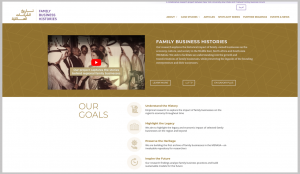
www.familybusinesshistories.org
A family’s entrepreneurial history informs both dimensions – it creates a sense of purpose in times of distress and it can provide a playbook (or just plain encouragement) to withstand storms. At Tharawat we have been committed to mapping and documenting those histories across the MENASA region, together with our research partners New York University Abu Dhabi for the past 10 years. As a result you can browse almost 100 profiles of historical family enterprises here https://www.familybusinesshistories.org/spotlights/.
Together, long-term orientation and instantaneous resourceful ingenuity form a powerful combination. They allow leaders to stay true to their long-term vision while being creatively adaptive in their short-term execution. It is a lesson in how a rich history can fuel a more resilient and resourceful future.
Helpful Links:
- Embedding Long-termism, Family Business UK Guide https://familybusinessuk.org/wp-content/uploads/2023/09/Embedding-Long-Termism.pdf
- Family Business Histories Checklist https://www.familybusinesshistories.org/case-studies/
About the Family Enterprises in a Region under Pressure Article Series
Family enterprises in the MENA region are facing unprecedented challenges – from geopolitical uncertainty and economic shifts to complex generational transitions.
In this article series, our General Manager, Farida El Agamy, draws on more than fifteen years of experience working with family enterprises across the region to reflect on the forces reshaping them today. Each article combines informed perspective with practical, on-the-ground insight, exploring key themes shaping the sector. The series aims to spark meaningful dialogue, deepen understanding, and offer a nuanced view of the evolving future of family businesses in the region.