
Family Enterprises in a Region under Pressure | The Internal Frontline
Managing family dynamics under extreme pressure is a complex matter – and can lead both to re-alignment or … exasperation.
When facing a major external disruption, a family enterprise may find itself fighting battles on two fronts: in the marketplace, and at the kitchen table. The external pressure of highly volatile environments and disrupted markets can either forge unprecedented unity or dangerously exacerbate dormant internal conflicts. Following conversations with families across the region about this sensitive reality, I believe it is important to explore navigating the family’s internal frontline while we are facing this challenging reality.
A Fork in the Road: Unity or Division?
During moments of disruptive and sudden pressure, in our research over the past twenty years we have seen families walk down two very different paths.
Many show a powerful sense of cohesion, where long-standing disagreements are set aside in the face of a singular, unifying goal: the survival of the enterprise and the protection of the family and its legacy. In these cases, the crisis acts as a clarifying force, reminding everyone of their shared purpose.
However, the opposite can also be true. We have been contacted by a family seeking guidance because the intense stress of the situation has inflamed an old, unresolved conflict, paralysing their ability to make critical decisions. This is a painful but important reality to acknowledge.
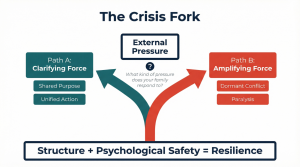
The Crisis Fork. Copyright Tharawat Family Business Forum, 2026.
The Psychology of Conflict and the Power of Structure
From a psychological perspective, this distinction is understandable. Intense fear and stress can cause a regression to old, hardened patterns of behaviour. When communication breaks down, trust fades, and the family’s ability to lead is compromised.
The antidote to this is not to pretend conflict doesn’t exist, but to create a structured environment of safety and trust, where family members can voice concerns and disagree constructively, without fear of personal attacks or retribution.
Even simple tools can be incredibly effective. Short, structured daily check-in meetings with a clear agenda can create a predictable rhythm and ensure all voices are heard. In higher-stakes situations, engaging a trusted, neutral third-party facilitator can help de-escalate tensions and guide the family toward productive solutions.
The “Right Time” to Work on Conflicts?
Certain members, when discussing cracks in the family cohesion, have raised the concern that right now is “not the right time to work on this” because they are “fire fighting”. And that is indeed a reality. However, there is a middle ground between either dedicating all our time and effort to the family conflict during an external crisis and not addressing it at all.
Taking proactive steps to mitigate, mediate and create space for family members to express themselves, while highlighting the urgency and real impact of the crisis on the family business may be the way to avoid exasperation and perhaps even garner support from unlikely allies.
I believe that managing these internal dynamics is not a distraction from the external crisis but is a core component of navigating it successfully. The strength of the enterprise is directly linked to the health of the family.
About the Family Enterprises in a Region under Pressure Article Series
Family enterprises in the MENA region are facing unprecedented challenges – from geopolitical uncertainty and economic shifts to complex generational transitions.
In this article series, our General Manager, Farida El Agamy, draws on more than fifteen years of experience working with family enterprises across the region to reflect on the forces reshaping them today. Each article combines informed perspective with practical, on-the-ground insight, exploring key themes shaping the sector. The series aims to spark meaningful dialogue, deepen understanding, and offer a nuanced view of the evolving future of family businesses in the region.